 Toll-Free 1-855-952-6526
 +44 1753 201 201
  61-2-86078986
  + 44 ( 0 ) 7739 716978
What if you could stand at the precise threshold where 1,500 years of silent prayer meets the delicate chisel of a master artisan, all while bypassing the 40-degree heat and sweltering chaos that often defines the Sahyadri hills? You likely recognize that a pilgrimage to the ajanta and ellora caves is a non-negotiable rite of passage for any worldly traveler seeking the soul of India, yet the reality of navigating these 64 distinct rock-cut sanctuaries can often feel like an exhausting trial rather than a royal sojourn. It’s a common concern that the sheer scale of the 30 caves at Ajanta and the 34 at Ellora might blur into a singular, dusty memory without the guiding hand of a dedicated historian to curate the experience.
This guide promises to illuminate the spiritual grandeur of these sites through a lens of absolute exclusivity, ensuring your exploration is defined by the rhythmic grace of a bespoke itinerary and profound historical insight. You’ll gain a sophisticated understanding of the 500-year gap that separates the monastic solitude of Ajanta from the multi-faith architectural explosion at Ellora. We’ll unveil how to transform this historic odyssey into a seamless experience, moving from the palatial comforts of our Blue Limousine on wheels to the very heart of India’s stone heritage as part of an elite journey where you truly live like royalty.
Key Takeaways
-
Unveil the profound spiritual evolution of these UNESCO twin-marvels by distinguishing the meditative, monastic isolation of Ajanta from the grand, public architectural splendor of the Ellora complex.
-
Marvel at the architectural impossibility of the Kailasa Temple, a monolithic masterpiece carved from the top-down out of a single basalt rock that continues to defy modern engineering logic.
-
Master the logistics of a sophisticated expedition with expert advice on navigating the rugged terrain and timing your visit to ensure a serene, unhurried encounter with history.
-
Discover how to transform your exploration of the ajanta and ellora caves into a regal odyssey by pairing these ancient stone halls with the palatial comforts of a luxury rail suite.
Table of Contents
-
Navigating the Ancient Labyrinths: Expert Tips for the Discerning Traveller
-
The Ultimate Sojourn: Visiting the Caves via the Deccan Odyssey
Unveiling the Majestic Splendour of Ajanta and Ellora Caves
The Sahyadri range holds a secret within its rugged basaltic embrace, where cliffs served as a divine canvas for artisans who spent fifteen centuries chiselling devotion into stone. When you step onto this hallowed ground, the air feels heavy with the echoes of ancient chants and the rhythmic strike of the hammer. These twin marvels represent more than just architectural prowess; they’re the beating heart of India’s spiritual heritage. Within these chambers, Buddhism, Hinduism, and Jainism coexist in a silent, stony embrace that defines the nation’s historical religious harmony.
Standing before these monuments, you witness a transformation of cold rock into fluid grace. It’s an emotional odyssey that transcends time, connecting the modern traveller to the visionary monks of the 2nd century BCE. The sheer scale of the ajanta and ellora caves evokes a sense of regal humility, reminding us that true luxury lies in the preservation of such timeless human achievement.
A Tale of Rediscovery and Royal Patronage
Historical records tell us the world nearly lost these treasures to the encroaching jungle. On April 28, 1819, a British officer named John Smith pursued a tiger into the Waghur River ravine, only to stumble upon the entrance to Cave 10. This accidental discovery brought the world’s gaze back to the masterpieces of Buddhist religious art that lay dormant for centuries under a veil of greenery.
Lavish funding for these sites came from powerful dynasties who viewed art as a bridge to the divine. The Vakataka kings patronized the Ajanta monastic retreats, while the Rashtrakuta dynasty later commissioned the staggering monolithic structures at Ellora. Today, these sites have transitioned from secluded sanctuaries for hermits into global icons, inviting guests on the Maharashtra Splendour to witness the pinnacle of royal heritage.
The Spiritual Geography of Aurangabad
You’ll find these wonders nestled near Chhatrapati Sambhaji Nagar, the historic city formerly known as Aurangabad. This location wasn’t chosen by chance; it was a strategic masterstroke by ancient planners. The site sat at the crossroads of the Dakshinapatha, a vital trade route connecting the northern plains to the bustling southern ports.
Ancient trade brought wealth, but it also brought a diverse exchange of ideas. Spiritual seekers and historians alike find that the ajanta and ellora caves offer a unique look at how geography influenced faith. The verticality of the Sahyadri basalt allowed for 34 excavations at Ellora and 30 at Ajanta. This specific geology enabled the creation of the world’s largest monolithic structure, the Kailasa Temple, which was carved from the top down by removing 200,000 tonnes of rock. It’s a landscape where nature and divinity converge, offering a curated experience of India’s soul.
A Tale of Two Sanctuaries: Comparing Ajanta and Ellora
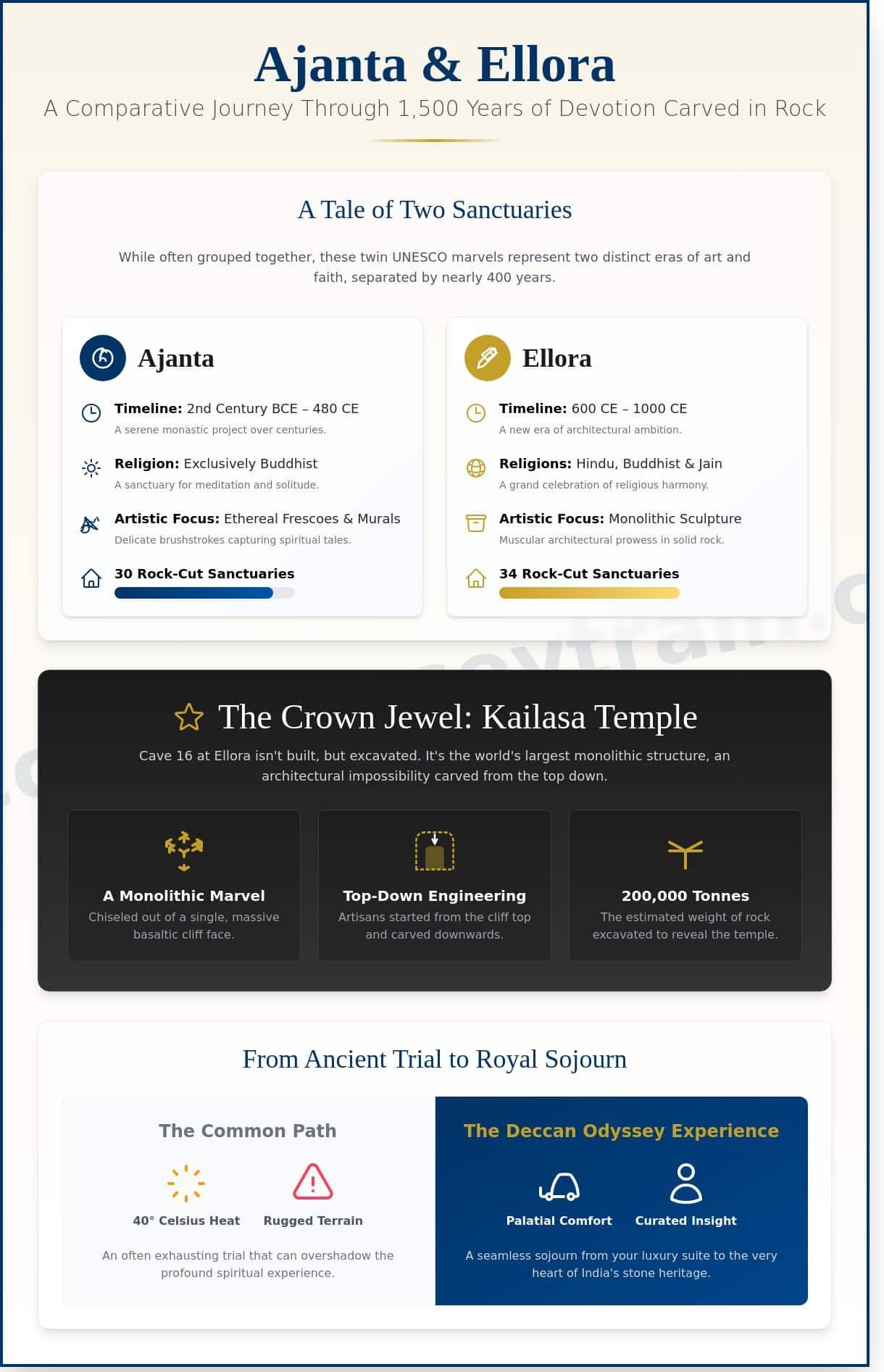
While often spoken of in a single breath, the ajanta and ellora caves represent two distinct epochs of human creativity, separated by nearly 400 years of silence. Ajanta, established between the 2nd century BCE and 480 CE, served as a secluded retreat for Buddhist monks who sought enlightenment within the steep, horseshoe-shaped Waghur River gorge. In contrast, Ellora emerged later, between 600 and 1000 CE, as a bustling center of trade and pilgrimage that celebrated a pluralistic society. Where Ajanta whispers of monastic isolation and quiet meditation, Ellora sings of public grandeur and the triumphant coexistence of three great faiths.
The artistic divergence between these two UNESCO World Heritage sites is equally profound. Ajanta is celebrated for its ethereal frescoes, where delicate brushstrokes capture the soft curve of a lotus or the gentle sorrow in a bodhisattva’s eyes. Ellora showcases a muscular architectural prowess. The artisans here traded the paintbrush for the chisel, carving monolithic structures from solid basalt. This transition reflects a shift from the introspective devotion of early Buddhism to the exuberant, multi-layered spirituality of the medieval era. Travelers embarking on a Maharashtra Splendour sojourn find that witnessing these contrasting styles offers a masterclass in the evolution of Indian aesthetics.
Ajanta: The Gallery of Ancient Buddhist Art
Stepping into the 29 caves of Ajanta feels like entering a silent, subterranean cathedral dedicated to the soul’s journey. These sanctuaries are famous for the "Ajanta Style" of painting, a technique that traveled along the Silk Road to influence art from Afghanistan to Japan. Cave 1 remains the ultimate highlight, housing the legendary paintings of Padmapani and Vajrapani. These figures, with their serene expressions and intricate jewelry, represent the pinnacle of 5th-century artistry. The walls also depict the Jataka tales, narrating the Buddha’s previous incarnations through vibrant, crowded scenes that offer a window into the daily life of ancient India.
Ellora: A Symphony in Stone for Three Faiths
Ellora stands as a testament to religious harmony, featuring 34 caves where Buddhist, Hindu, and Jain shrines stand side-by-side in a 2-kilometer stretch of the Sahyadri hills. The site is a unique artistic creation and a technological exploit that demonstrates the sheer ambition of the Rashtrakuta and Kalachuri dynasties. While the early Buddhist caves are simple and meditative, the later Hindu and Jain structures, such as the Indra Sabha in Cave 32, are marvels of complexity. These Jain caves are particularly renowned for their dense, ornate carvings, featuring intricate ceiling designs and statues of Tirthankaras that seem to breathe within their stone alcoves.
The Crown Jewel: Why Kailasa Temple at Ellora Defies Logic
As your Blue Limousine on wheels glides toward the Sahyadri hills, you’re approaching a feat of engineering that challenges the very limits of modern comprehension. The Kailasa Temple, designated as Cave 16, stands as the undisputed heart of the ajanta and ellora caves. It isn’t a building in the traditional sense; it’s a colossal sculpture carved from a single, massive basalt cliff. Architects today still marvel at how 8th-century craftsmen removed 200,000 tonnes of volcanic rock over a mere 18 years. They worked with a top-down methodology, starting at the peak and chiseling downward to the floor. This reversed logic ensured that no scaffolding was ever required. The result is a breathtaking replica of Mount Kailash, the celestial home of Lord Shiva, rising three stories high into the Maharashtra sky.
Architectural Mastery Beyond Human Capability
The precision found within these stone walls is staggering. Life-sized elephants stand guard at the base, carved with such anatomical accuracy they seem ready to breathe. Ancient master-craftsmen managed ventilation and light by leaving strategic openings as they descended, a feat of planning that seems impossible without modern blueprints. The temple walls serve as a stone library, featuring the finest surviving examples of Indian art through intricate friezes. You’ll find the epic narratives of the Ramayana and Mahabharata unfolding across the panels, each scene detailed with a fluidity that belies its rigid medium.
Experiencing the Temple as a Royal Guest
To truly grasp the scale of this monolithic wonder, we recommend ascending the surrounding cliffs. This vantage point offers a bird’s-eye view of the temple’s layout, revealing the sheer audacity of the excavation. On a Maharashtra Splendour journey, your private expert guide becomes indispensable. They decode the complex iconography of the stone galleries, transforming silent carvings into living legends. Despite the grandeur, you’ll find moments of profound stillness in the inner sanctum. It’s here, away from the midday heat, that the spiritual weight of the ajanta and ellora caves truly settles into your soul, offering a connection to the divine that has endured for over twelve centuries.
Navigating the Ancient Labyrinths: Expert Tips for the Discerning Traveller
Stepping into the ajanta and ellora caves requires more than just a ticket; it demands a strategic approach to the Deccan’s formidable terrain. The primary challenge for many is the physical ascent, particularly the 250 steps leading to the higher viewpoints at Ajanta or the expansive 2 kilometer walk across the Ellora complex. To master this, we recommend arriving exactly at 8:00 AM when the gates open. This early start grants you a two hour window of cool, translucent light before the mercury climbs toward 38°C in the afternoon. Choosing a curated, private excursion through the Maharashtra Splendour sojourn ensures you’re accompanied by a scholar-guide who paces the journey to your comfort, providing a stark contrast to the hurried, crowded cadence of generic group tours.
Seasonal Wisdom for the Deccan Plateau
The most temperate window for your pilgrimage falls between October and March, when daytime temperatures hover around a pleasant 28°C. If you seek a more dramatic atmosphere, the monsoon months of June through September transform the scorched landscape into a vibrant emerald sanctuary. During this time, the seven waterfalls of the Waghur River cascade with renewed vigor near Ajanta. Regardless of the season, seek refuge in the cool shadows of the inner sanctums by 12:00 PM to avoid the zenith of the tropical sun. It’s a time when the stone feels most alive, whispering secrets of a thousand years ago.
The Art of Slow Heritage Exploration
True appreciation of these UNESCO sites cannot be rushed. Dedicate a minimum of 6 hours to each location to absorb the intricate details of the 34 monasteries and temples at Ellora. Your day bag should remain light yet purposeful. It’s the small luxuries, like a silk scarf to shield from dust or a pair of 8×42 binoculars to view ceiling frescoes, that elevate a simple visit into a royal expedition. Include a 1.5 liter reusable flask to maintain hydration throughout the day.
-
Photography: Flash is strictly prohibited to protect pigments dating back to the 2nd century BCE. Use a tripod only where permitted.
-
Attire: Wear breathable linen or cotton that covers the shoulders and knees. This honors the spiritual sanctity of the ajanta and ellora caves while ensuring thermal comfort.
-
Footwear: Opt for high-grip walking shoes; the ancient basalt floors can be surprisingly slick.
Every corner of these labyrinths offers a new revelation of India’s soul. By moving with intention and respecting the rhythm of the land, you transform a mere sightseeing trip into a transformative odyssey. You’re not just a tourist; you’re a guest of history itself.
Experience the grandeur of these ancient wonders from the comfort of your own private palace on wheels. Book your Maharashtra Splendour journey today.
The Ultimate Sojourn: Visiting the Caves via the Deccan Odyssey
To witness the ajanta and ellora caves is to stand before the zenith of ancient human ambition, yet the journey through the rugged Deccan terrain often demands a physical resilience that can overshadow the spiritual experience. The Deccan Odyssey’s "Maharashtra Splendour" itinerary elegantly solves this by transmuting a demanding expedition into a royal event of unparalleled grace. You won’t find yourself navigating the logistical complexities of rural Maharashtra or contending with the heat of the midday sun in standard transport. Instead, the transition is fluid and dignified. You’ll step from the "Blue Limousine" into private, climate-controlled luxury transport that whisks you directly to the temple gates, ensuring your energy is reserved entirely for the marvels of the stone.
After a day spent exploring the 34 monasteries and temples of Ellora, the return to the train offers a sanctuary of immediate indulgence. Your Presidential Suite, a 191-square-foot haven adorned with silk and intricate wood carvings, provides a cool respite from the golden dust of the plateau. The grime of the day vanishes within the marble-clad en-suite facilities before you head to the Ayushpa spa. Here, ancient Indian wellness techniques rejuvenate your weary muscles, preparing you for an evening of sophisticated leisure. Dinner in the Peshwa I or Peshwa II restaurant cars is an affair of state; gourmet chefs prepare local Malvani delicacies and international classics that rival the finest kitchens in Mumbai, served on fine china as the landscape glides past your window.
The Luxury of a Curated Itinerary
The Deccan Odyssey manages every intricate detail, from securing priority permits to providing expert historians who breathe life into the silent stone of the ajanta and ellora caves. This curated approach ensures you bypass the crowds and focus on the artistry. You’ll travel alongside a select group of cultural connoisseurs who share a refined appreciation for India’s heritage. This eight-day journey is designed so the time spent traversing the tracks is as enchanting as the destinations. Each of the 21 coaches reflects the aesthetic of a different royal era, making the train a moving palace that honors the very history you’ve come to witness.
Begin Your Own Cultural Odyssey
We invite you to experience the Maharashtra Splendour in 2026, where the grandeur of the past meets the pinnacle of modern elite travel. These caves are more than mere monuments; they represent a life-changing testament to human devotion that has survived for over 1,500 years. Every carving tells a story of faith and patience. Don’t just visit history; inhabit it with the dignity it deserves. Embark on your journey with the Deccan Odyssey and discover the soul of India from the comfort of your palatial home on wheels.
Begin Your Royal Passage to India’s Ancient Heart
The silent basalt cliffs of the ajanta and ellora caves hold the echoes of 1,500 years of spiritual devotion and architectural genius. You’ve explored the 30 rock-cut Buddhist monuments of Ajanta and stood in awe before the 34 monasteries and temples of Ellora. The monolithic Kailasa Temple remains a feat of engineering that defies logic; it required the manual removal of 200,000 tonnes of rock to create its divine silhouette. To witness these UNESCO World Heritage sites is to touch the very soul of ancient India through a lens of profound historical reverence.
The Deccan Odyssey, a World Travel Award winner for luxury rail travel for 5 consecutive years, offers the most refined way to traverse this historic landscape. As the official partner of the Maharashtra Tourism Development Corporation (MTDC), our "Blue Limousine on wheels" provides all-inclusive 5-star hospitality that mirrors the grandeur of the sites you visit. You’ll find yourself enveloped in palatial comfort while our expert guides unveil the secrets of these stone labyrinths. It’s time to transform your travel dreams into a legendary sojourn. Discover the Maharashtra Splendour Itinerary and prepare for a transformative odyssey that stays with you forever.
Frequently Asked Questions
What is the best time of year to visit the Ajanta and Ellora caves?
The most enchanting season to embark on your odyssey to the ajanta and ellora caves is between November and February when the temperate climate hovers between 10°C and 25°C. These cooler months provide a respite from the scorching heat of the Deccan plateau, allowing you to traverse the stone galleries in absolute comfort. While the monsoon season from June to September paints the landscape in emerald hues, the winter months remain the premier choice for a curated, regal exploration.
Can I visit both Ajanta and Ellora caves in a single day?
You shouldn’t attempt to visit both sites in a single day as they sit approximately 100 kilometers apart, requiring a three-hour journey through the winding Sahyadri terrain. Rushing through the ajanta and ellora caves would diminish the majesty of the 64 total excavations. To truly live like royalty and absorb every intricate detail, we recommend dedicating at least one full day to each location, ensuring your sojourn remains unhurried and deeply immersive.
Is there a dress code for visiting the caves?
While there’s no official imperial decree on attire, you should wear modest clothing that covers your shoulders and knees to respect the spiritual heritage of these 34 monasteries at Ellora. Sturdy walking shoes are essential for navigating the uneven basalt steps and rugged pathways. Remember to bring a pair of socks, as you’ll need to remove your footwear before entering the sanctums of the 29 caves at Ajanta to protect the ancient floors.
How far are the Ajanta and Ellora caves from Mumbai?
The legendary caves are located approximately 330 kilometers from Mumbai to Ellora and nearly 400 kilometers to Ajanta. Traveling by road from the bustling metropolis typically takes between 7 and 9 hours depending on the traffic and route. For those seeking the ultimate grand experience, our Blue Limousine on wheels bridges this distance with palatial ease, transforming the long traverse into a seamless journey of luxury and discovery across the heart of Maharashtra.
Are the caves accessible for travellers with limited mobility?
Navigating the steep ascents is challenging for guests with limited mobility, yet the local authorities provide palanquins or dolis carried by four porters for a fee of approximately 1,500 to 2,000 rupees. These traditional seats allow every traveler to ascend the cliffs and witness the stone splendor without physical strain. While the terrain is naturally rugged, these curated services ensure that the soul of India remains accessible to every curious guest seeking its ancient treasures.
Why are the Ajanta caves famous for paintings while Ellora is known for sculpture?
Ajanta’s fame rests upon its 2nd-century BCE tempera paintings that depict the Jataka tales with exquisite pigment, while Ellora represents the pinnacle of 6th-century rock-cut architecture. The 30 caves at Ajanta were secluded retreats for monks, fostering a delicate art form that survived for 2,000 years. In contrast, Ellora’s 34 caves showcase a dramatic evolution of sculpture, reflecting a harmonious blend of Buddhist, Hindu, and Jain traditions carved directly into the mountain’s face during a later era.
Do I need a special permit to visit these UNESCO sites?
You don’t need a special government permit to visit these majestic monuments, though you must purchase an entry ticket issued by the Archaeological Survey of India. For foreign travelers, the fee is currently 600 rupees per person, while domestic guests pay 40 rupees. These tickets grant you access to the entire complex for the day. It’s wise to book your passage online through the official portal to ensure your entry into these legendary stone corridors is effortless.
What is the significance of the Kailasa Temple at Ellora?
The Kailasa Temple in Cave 16 stands as the world’s largest monolithic structure, carved from a single basalt cliff starting from the summit down to the base. Commissioned by King Krishna I in the 8th century, this architectural marvel required the removal of 200,000 tonnes of rock over 18 years. It’s a palatial tribute to Lord Shiva, featuring intricate friezes and towering pillars that exemplify the height of Indian craftsmanship and the regal ambition of the Rashtrakuta dynasty.