 Toll-Free 1-855-952-6526
 +44 1753 201 201
  61-2-86078986
  + 44 ( 0 ) 7739 716978
The Taj Mahal in Agra India history is far more than a world-famous monument—it is a timeless symbol of love, craftsmanship, and imperial legacy, shaped by over 20,000 skilled artisans across 22 years (1632–1653). Recognized globally for its breathtaking white marble beauty, the Taj Mahal stands as one of the most visited landmarks in the world. Yet, beyond the iconic silhouette lies a deeper narrative often overlooked by standard travel guides and crowded itineraries.
For travelers seeking a richer and more meaningful experience, understanding the Taj Mahal in Agra India history unlocks a fascinating journey into the heart of the Mughal Empire. Commissioned by Emperor Shah Jahan in memory of his beloved wife Mumtaz Mahal, this UNESCO World Heritage Site is a masterpiece of Indo-Islamic architecture, blending Persian, Ottoman, and Indian influences. From its intricate pietra dura inlay work to its perfectly symmetrical Mughal gardens, every element reflects precision, symbolism, and artistic excellence.
This guide goes beyond surface-level tourism, offering insights into the architectural brilliance, historical significance, and cultural heritage that make the Taj Mahal a true wonder of the world. Whether you’re planning your first visit or looking to deepen your knowledge, exploring the Taj Mahal in Agra India history will transform your perspective and elevate your travel experience.
Key Takeaways
Unveil the poignant saga of Emperor Shah Jahan and Mumtaz Mahal, exploring how their eternal romance inspired the creation of this majestic, white marble testament to devotion.
Delve into the Taj Mahal in Agra India history to understand how a sophisticated fusion of Persian, Islamic, and Indian architectural styles achieved a state of ethereal perfection.
Discover the monumental effort of 20,000 master artisans who spent twenty-two years hand-crafting every exquisite detail of this palatial UNESCO World Heritage site.
Explore the symbolic symmetry of the Charbagh gardens and the flanking red sandstone structures that complete this harmonious representation of a celestial paradise.
Learn how to transition seamlessly from the regal comfort of the Deccan Odyssey to the gates of Agra on a curated Indian Odyssey itinerary.
Table of Contents
The Eternal Love Story: The Origin and History of the Taj Mahal
Architectural Splendor: Unveiling the Design of the White Marble Wonder
A Monumental Feat: The Construction and Craftsmanship of the 17th Century
Beyond the Mausoleum: Exploring the Taj Complex and Its Sacred Geometry
The Eternal Love Story: The Origin and History of the Taj Mahal
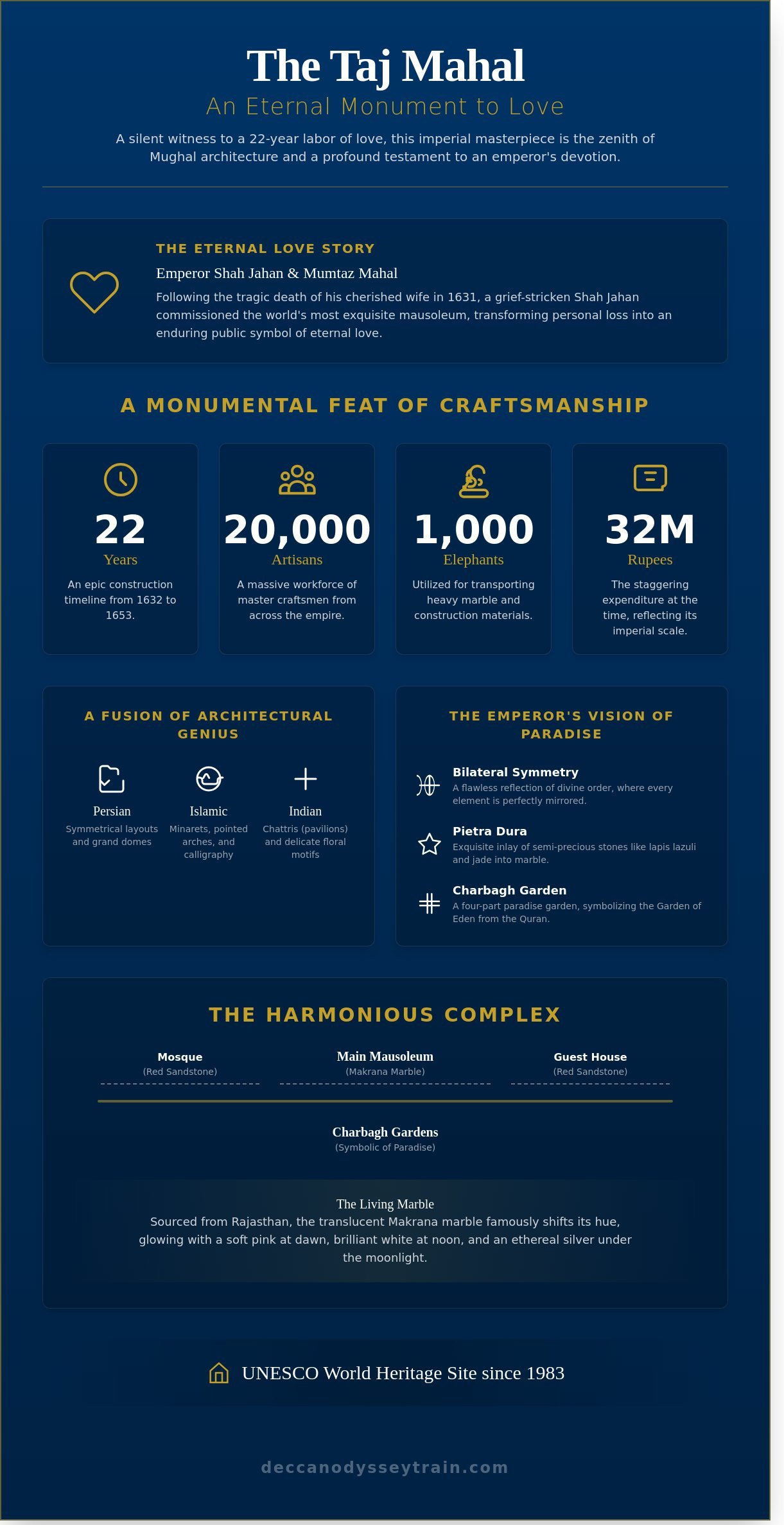
Agra served as the vibrant, beating heart of the Mughal Empire during the 17th century, a city where unimaginable opulence and absolute power converged under the sophisticated reign of Emperor Shah Jahan. It was within this imperial capital that the history of Taj Mahal began to unfold, not merely as a massive construction project, but as a profound, tangible manifestation of a sovereign’s shattered heart. The monument stands today as an unrivaled masterpiece of Mughal architecture, a gleaming ivory-white marble mausoleum that has rightfully earned its place as a UNESCO World Heritage site since its designation in 1983. This architectural marvel represents the absolute zenith of Indo-Islamic art, blending Persian, Indian, and Islamic design elements into a singular, harmonious vision of beauty that continues to captivate travelers who arrive at its gates.
Following the sudden and tragic death of his favorite consort in 1631, the Emperor sought to transform his private, agonizing desolation into a public testament of devotion that would endure for centuries. For those traversing the northern plains of India on a luxurious Indian Odyssey, the monument remains the ultimate destination, a place where history breathes through every polished stone and intricate inlay. The transition from a husband’s personal grief to a monumental public landmark involved the labor of approximately 20,000 artisans and a staggering expenditure of 32 million rupees at the time.
Who Was Mumtaz Mahal?
Arjumand Banu Begum, known to the world by her title Mumtaz Mahal, was far more than a queen; she was Shah Jahan’s inseparable companion and most trusted political advisor. Her life was defined by a deep, unwavering devotion that ended tragically in June 1631 during the birth of their fourteenth child in Burhanpur. According to the Taj Mahal Wikipedia entry, her loss plunged the imperial court into two years of official mourning, eventually leading the Emperor to commission the most exquisite tomb ever conceived by man. Understanding the** **history requires one to look beyond the marble to the central chamber of the mausoleum, where her remains were eventually moved from their temporary grave to rest eternally beneath the great dome.
Shah Jahan’s Vision for a Terrestrial Paradise
Shah Jahan possessed an unwavering obsession with symmetry, viewing mathematical perfection as a physical reflection of divine order and celestial harmony. He envisioned the Taj Mahal as a replica of the “Throne of God” resting above the gardens of Paradise, ensuring every minaret, arch, and water channel mirrored its counterpart with absolute, breathtaking precision. The Emperor’s meticulous planning focused on several key architectural elements:
Bilateral Symmetry: Every structure on the main axis is perfectly balanced by an identical structure on the opposite side.
Pietra Dura: The use of semi-precious stones like lapis lazuli and jade inlaid into white marble to create floral motifs.
Charbagh Layout: The traditional Mughal garden divided into four parts by walkways or flowing water.
The entire complex functions as a symbolic representation of the Garden of Eden where the departed soul finds eternal peace amidst flowing waters and lush, curated greenery.
Architectural Splendor: Unveiling the Design of the White Marble Wonder
The Taj Mahal isn’t merely a building; it’s a lyrical masterpiece that harmonizes Persian elegance with the sturdy grace of Indian craftsmanship. Constructed between 1631 and 1648, the mausoleum utilizes translucent white Makrana marble sourced from the mines of Rajasthan, a material that possesses a rare, ethereal quality. This stone allows the monument to shift its hue throughout the day, glowing with a soft, roseate pink at dawn and a ghostly, iridescent silver under the full moon. According to the UNESCO World Heritage Centre, this site represents the absolute pinnacle of Mughal art, blending diverse cultural influences into a singular, breathtaking vision. The master artisans employed the “Pietra Dura” technique, an intricate process where thousands of semi-precious stones like lapis lazuli, jade, and mother-of-pearl were inlaid into the marble to create delicate, everlasting floral patterns. Every inch of the structure adheres to a rigid, mathematical symmetry that creates a sense of profound, rhythmic serenity.
The Symphony of the Four Minarets
Each of the four minarets, standing 40 meters tall, was designed with a deliberate outward tilt of a few degrees. This ingenious engineering ensures that in the event of a catastrophic earthquake, the towers would fall away from the central tomb rather than crushing the sacred inner sanctum. These slender pillars frame the main structure perfectly, drawing the eye upward toward the heavens. Along the arched entrances, you’ll find elegant calligraphic inscriptions of Quranic verses, crafted in black marble that appears uniform in size from top to bottom. This is a clever optical illusion achieved by gradually increasing the font size as the text ascends the walls.
The Main Dome and the Lotus Motif
The crowning glory of the Taj Mahal is its magnificent “onion dome,” which rises to a height of 35 meters above the base. It’s topped by a gilded brass finial that once was solid gold, blending Islamic crescents with the trident of Shiva to signify a union of cultures. The base of the dome is adorned with a carved lotus motif, a traditional Indian symbol of purity that bridges the gap between disparate artistic traditions. Inside the main chamber, the acoustics are so refined that a single note can echo for nearly 30 seconds, a haunting reminder of the eternal nature of the love story that defines the Taj Mahal in Agra, India** history**. As you plan your own Indian Odyssey, witnessing this architectural marvel becomes a transformative highlight of your royal sojourn through the heart of the subcontinent.
A Monumental Feat: The Construction and Craftsmanship of the 17th Century
The creation of this ivory-white masterpiece was an undertaking of unparalleled scale, spanning a meticulous 22-year period from 1631 to 1653. Shah Jahan summoned a workforce of 20,000 artisans, including master stonecutters and delicate calligraphers, to realize his vision of eternal love. To facilitate this grand endeavor, an army of 1,000 elephants labored across the dusty plains to transport heavy slabs of Makrana marble from Rajasthan. By the time the final flourish was added in 1653, the Imperial treasury had expended an estimated 32 million rupees, a sum that reflects the absolute opulence of the Mughal era. This monumental investment solidified the Taj Mahal in Agra India** history** as the definitive peak of human achievement and royal devotion.
Travelers today can experience this same sense of wonder when they arrive in Agra via the Indian Odyssey, transitioning from the modern luxury of their private cabins to the timeless splendor of the Mughal court. The sheer logistical brilliance required to coordinate such a project remains a testament to the sophisticated administrative power of the empire. It wasn’t just a building project; it was a decades-long devotion that reshaped the landscape of the Yamuna River.
The Master Architects of the Empire
While the Emperor provided the initial inspiration, the architectural genius is largely attributed to Ustad Ahmad Lahauri, the chief designer who orchestrated a symphony of Persian, European, and Central Asian influences. This international collaboration ensured that every arch and dome resonated with a global aesthetic of luxury. According to the UNESCO World Heritage Centre, the site stands as the finest architectural achievement in the entire range of Indo-Islamic architecture, representing a perfect balance of proportion and ornamentation. Contrary to the persistent, dark legends suggesting that the artisans were maimed to prevent them from replicating the work, historical records indicate a high degree of respect for these craftsmen. Many were rewarded with land and wealth, ensuring their families prospered for generations.
Materials Sourced from Across the Silk Road
The materials used were as diverse as the empire itself, sourced from the furthest reaches of the Silk Road to create a palette of unrivaled beauty. The foundation and surrounding structures utilized red sandstone from nearby Fatehpur Sikri, creating a dramatic contrast against the central mausoleum. During construction, a massive brick scaffolding was erected, so extensive that engineers feared it would take years to dismantle. However, the Emperor decreed that anyone could keep the bricks they removed, and the entire structure was reportedly cleared by local citizens in a single day. The precious stones used in the inlay work included:
Lapis Lazuli: Brought from the rugged mountains of Afghanistan.
Jade: Carried from the imperial courts of China.
Turquoise: Sourced from the high plateaus of Tibet.
Carnelian: Transported from the distant shores of Arabia.
The intricate pietra dura work, where these semi-precious stones are embedded into the marble, remains so seamless that it’s difficult to feel the joints with a fingertip. This level of detail ensures that the Taj Mahal remains an enduring symbol of a golden age where art and power were perfectly aligned.
Beyond the Mausoleum: Exploring the Taj Complex and Its Sacred Geometry
Step through the Great Gate, known as the Darwaza-i rauza, and you’ll find yourself at the threshold of a celestial vision. This massive red sandstone portal serves as more than an entrance; it’s a deliberate transition from the chaotic noise of the world to the hushed sanctity of a royal tomb. The gate’s intricate calligraphy invites the pure of heart to enter Paradise, setting a tone of spiritual reverence that defines the Taj Mahal in Agra India history. This 151-foot structure acts as a veil, momentarily obscuring the tomb before revealing its full splendor in a dramatic burst of perspective.
The Sacred Garden of the Mughals
Within the complex lies the Charbagh, a 300-meter square garden meticulously divided by marble water channels into four quadrants. These paths represent the four rivers of Paradise mentioned in ancient texts, symbolizing water, milk, wine, and honey. Each quadrant is further subdivided into 16 sunken flowerbeds, creating a lush tapestry that once overflowed with fruit trees and fragrant blooms. Unlike traditional Mughal tombs where the monument sits at the center, the Taj is uniquely positioned at the northern edge. This placement ensures the reflecting pools capture the dome’s perfect symmetry, doubling its ethereal beauty for every guest. Across the river, the Mehtab Bagh, or Moonlight Garden, offers a mirror-image perspective designed for nocturnal contemplation, ensuring the monument is honored from every angle.
Flowing along the northern boundary, the Yamuna River acts as a majestic backdrop that enhances the monument’s scale. The river’s presence was a masterstroke of engineering and aesthetics, providing a cooling breeze and a steady water supply for the fountains. Its dark waters contrast sharply with the translucent Makrana marble, making the tomb appear as if it’s floating between the earth and the heavens. This connection to the river is a vital part of the Taj Mahal in Agra India history, as it provided the logistical lifeline for the 20,000 artisans who labored here for over two decades.
The Mosque and the Jawab
Symmetry remains the soul of this site. Two identical red sandstone buildings flank the central mausoleum to maintain visual equilibrium. To the west stands the Mosque, a functional place of worship facing Mecca. Its floor is meticulously inlaid with the outlines of 539 prayer mats, each carved with delicate precision into the stone. To the east sits its twin, the Jawab or “Echo,” which served as a guest house and exists primarily to satisfy the Mughal obsession with balance. You can witness the rich textures and deep ochre hues of these structures by exploring the Deccan Odyssey gallery for visual inspiration.
Experience this architectural marvel in person on a curated journey through the heart of India’s golden age. Book your Indian Odyssey tour today and witness the splendor of Agra from the comfort of our regal train.
The Indian Odyssey: Witnessing History in Regal Comfort
To witness the Taj Mahal is to behold the very soul of Mughal grandeur, an experience that reaches its zenith when curated as the crowning jewel of the Indian Odyssey itinerary. As the “Blue Limousine” glides gracefully across the iron tracks, guests find themselves enveloped in an atmosphere of timeless elegance before stepping into the vibrant pulse of Uttar Pradesh. This transition from the plush, silk-draped cabins to the marble-clad gates of Agra feels like a seamless passage through time. Luxury rail travel provides a rare, unhurried perspective on the Taj Mahal, allowing travelers to absorb the weight of centuries without the frantic pace of modern transit. Those who choose the Heritage Odyssey discover that the journey itself is designed to mirror the architectural precision of the monuments they visit, offering a prestigious life event rather than a simple vacation.
The experience of traversing the Mughal heartland aboard this palatial train ensures that every moment is steeped in splendor. While the world outside moves with a chaotic energy, the interior of the Deccan Odyssey remains a sanctuary of calm. This unhurried pace allows for a deeper connection with the landscape, unveiling the stories of emperors and architects in a way that standard travel simply cannot match. It is a transformative voyage that treats every guest with the reverence traditionally reserved for a deity.
Agra: A Royal Stop on the Deccan Odyssey
Guests enjoy personalized, private excursions that reveal the city’s secrets far beyond the famous ivory-white dome. While the Taj Mahal remains the centerpiece, the itinerary includes guided explorations of the red sandstone bastions of Agra Fort, established as a primary residence by Emperor Akbar in 1565, and the delicate marble inlay of Itmad-ud-Daulah. Every detail is handled with the grace of a royal host, ensuring your immersion into the monument is both profound and comfortable. For those seeking a deeper dive into the northern heartland, the Indian Sojourn offers an expansive, 8-day view of the region’s cultural tapestry.
Planning Your Royal Sojourn for 2026
The ideal months for capturing the perfect morning light on the marble are between October and March, when the temperatures range from a pleasant 10°C to 25°C. For the 2026 season, travelers can secure the ultimate sanctuary by booking a Presidential Suite, which offers 205 square feet of private luxury and dedicated butler service. Early planning ensures access to the most coveted cabins and exclusive special offers for upcoming departures. It’s a chance to traverse the landscape in a manner that honors the legendary hospitality of the Maharajas while enjoying modern, elite amenities and creating memories that will resonate for a lifetime.
Embark on Your Own Royal Pilgrimage to the Marble Wonder
The story of the Taj Mahal remains an unrivaled testament to devotion, beginning in 1631 when Emperor Shah Jahan envisioned a monument that would transcend time itself. You’ve explored the intricate craftsmanship of 20,000 artisans and the flawless symmetry of the 42-acre complex, gaining a deeper understanding of the Taj Mahal in Agra India. This 17th-century marvel isn’t just a structure of white marble; it’s a profound cultural anchor that continues to define the spirit of the nation. The Deccan Odyssey invites you to witness this architectural masterpiece through a lens of unparalleled grace. As India’s leading luxury train, our Blue Limousine on wheels offers an all-inclusive luxury rail experience where every detail is meticulously curated. You’ll enjoy expert-led heritage excursions that reveal the hidden secrets of the Mughal era while living like royalty in our palatial cabins. It’s time to transform your travel dreams into a legendary sojourn across the golden landscapes of the subcontinent. Experience the majesty of the Taj Mahal on a curated Indian Odyssey with Deccan Odyssey and discover the soul of India in absolute splendor. We’re ready to welcome you to a world of timeless elegance and magic.
Frequently Asked Questions
Who built the Taj Mahal and why was it constructed?
Mughal Emperor Shah Jahan commissioned the monument in 1632 as a final resting place for his beloved wife, Mumtaz Mahal, who passed away in 1631. This ethereal ivory-white marble mausoleum stands as the ultimate testament to the Taj Mahal in Agra India history, reflecting a grief-stricken emperor’s devotion through unparalleled architectural splendor. It’s a structure that transcends time, inviting every guest to witness the depth of imperial love.
How long did it take to build the Taj Mahal in Agra?
The construction of this majestic masterpiece required approximately 22 years to reach completion, beginning in 1632 and concluding around 1653. A massive workforce of 20,000 artisans and craftsmen from across India, Persia, and Europe collaborated to perfect every intricate detail of the 42-acre complex. Records indicate that over 1,000 elephants were utilized to transport the heavy marble and building materials from quarries located 300 kilometers away.
Can you go inside the Taj Mahal to see the tombs?
Travelers can enter the central chamber to view the exquisite cenotaphs of Shah Jahan and Mumtaz Mahal, which are adorned with delicate semi-precious stone inlays. The actual graves lie in a quiet lower crypt, which isn’t typically open to the public to preserve the sanctity of the site. Walking through the cool, marble halls provides an intimate glimpse into the opulence that defined the Mughal dynasty’s golden age.
Why does the Taj Mahal change color throughout the day?
The Taj Mahal’s translucent Makrana marble absorbs and reflects the changing light, shifting from a soft pinkish hue at sunrise to a brilliant white under the midday sun. By night, especially during the full moon, the monument takes on a mystical golden glow. This phenomenon offers a sensory delight that feels like a choreographed dance of light, making every moment of your visit truly unique.
Is the Taj Mahal considered one of the Seven Wonders of the World?
The Taj Mahal earned its prestigious place as one of the New Seven Wonders of the World in 2007 after a global poll attracted over 100 million votes. This UNESCO World Heritage site continues to represent the pinnacle of Mughal artistry and remains an essential stop on any curated Indian odyssey. It’s a legendary landmark that captures the imagination of every traveler traversing the historic plains of Uttar Pradesh.
What is the best way to visit the Taj Mahal as part of a luxury tour?
The most regal way to experience this wonder is through a journey on the Deccan Odyssey, often referred to as the Blue Limousine on wheels. Guests enjoy a seamless transition from their palatial private cabins to the gates of the monument, ensuring an exclusive and unhurried exploration of the Taj Mahal in Agra India history with expert guides. This curated sojourn allows travelers to live like royalty while discovering the soul of India.
What happened to Shah Jahan after the Taj Mahal was completed?
Following the completion of his architectural masterpiece, Shah Jahan was deposed by his son, Aurangzeb, in 1658 and spent his final 8 years confined within the Agra Fort. From his quarters in the Musamman Burj, he spent his days gazing across the Yamuna River at the shimmering Taj Mahal until his death in 1666. He was eventually laid to rest beside his wife, reuniting the royal couple forever.
Are there any specific dress codes for visiting the Taj Mahal in 2026?
Visitors in 2026 should wear modest clothing that covers shoulders and knees to respect the cultural and religious significance of the site. While there’s no formal royal dress code, wearing breathable fabrics like linen or cotton is recommended for the 35 degree Celsius Agra heat. You’ll receive shoe covers at the entrance to protect the pristine marble floors of the main mausoleum during your enchanting visit.