 Toll-Free 1-855-952-6526
 +44 1753 201 201
  61-2-86078986
  + 44 ( 0 ) 7739 716978
Some destinations impress through scale. Others leave their mark through silence, detail and the sense that you have stepped into another age. The Ajanta Caves belong firmly in the latter category.
Carved into a dramatic horseshoe-shaped gorge in Maharashtra, these ancient Buddhist sanctuaries preserve some of India’s most celebrated murals, sculptures and rock-cut architecture. Their artistry spans centuries, offering an extraordinary window into Buddhist thought, storytelling and craftsmanship.
For travellers aboard the Deccan Odyssey, Ajanta is particularly special because it features on two distinctive journeys: the Maharashtra Splendour and the Maharashtra Wild Trail. Both are 7-night / 8-day luxury rail itineraries, but each approaches Maharashtra from a different perspective. One combines heritage, vineyards and the coast; the other blends UNESCO monuments with some of India’s most exciting wildlife reserves.
Discover the train and its journeys at Deccan Odyssey.
Why the Ajanta Caves Are So Important
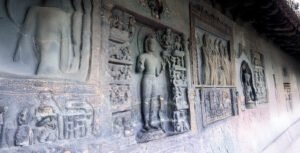
The Ajanta Caves are among India’s greatest archaeological treasures and are recognised as a UNESCO World Heritage Site. They are renowned for their ancient Buddhist paintings, sculptures and rock-cut spaces depicting stories associated with the life and teachings of Buddha.
Unlike a conventional monument, Ajanta feels immersive.
The caves are set within a natural gorge, and entering them means moving from bright daylight into dimly lit interiors where ancient paintings and carved figures emerge gradually from the stone.
That atmosphere is part of what makes the experience so powerful.
The site allows visitors to appreciate not only the skill of the artisans who created these works, but also the spiritual purpose of the caves themselves.
Visiting Ajanta on the Maharashtra Splendour
The Maharashtra Splendour is one of the Deccan Odyssey’s signature journeys and follows a route through Mumbai, Nashik, Ellora Caves, Ajanta Caves, Kolhapur, Goa, Sawantwadi and back to Mumbai.
It is a particularly appealing itinerary for travellers who want to combine architecture, culture, wine, cuisine and coastal India within a single luxury train journey.
Ajanta appears on Day 4 of the Maharashtra Splendour itinerary. Guests arrive at Pachora railway station and continue by road to the caves. The official itinerary describes a morning visit to the UNESCO site before returning to the Deccan Odyssey for lunch and a relaxed afternoon onboard.
That balance is one of the strengths of the journey.
You can spend the morning immersed in ancient Buddhist art and archaeology, then return to the comfort of your cabin, enjoy lunch and unwind while the train continues towards the next destination.
Maharashtra Splendour: Heritage Beyond Ajanta
Ajanta is one of the itinerary’s great highlights, but it sits within a wider cultural journey.
Before reaching Ajanta, guests explore Nashik, celebrated for its vineyards, and the remarkable Ellora Caves, another UNESCO World Heritage Site. Later, the itinerary continues to Kolhapur, the coastal landscapes and heritage of Goa, and Sawantwadi.
The contrast between Ajanta and Ellora is particularly fascinating.
Ajanta is celebrated for delicate Buddhist murals and sculptural storytelling, while Ellora is renowned for monumental rock-cut architecture reflecting Buddhist, Hindu and Jain traditions. The Deccan Odyssey’s own Maharashtra Splendour material positions the two cave complexes as central cultural anchors of the journey.
For travellers interested in India’s artistic and religious history, experiencing both within the same itinerary is exceptional.
Visiting Ajanta on the Maharashtra Wild Trail
The Maharashtra Wild Trail offers an entirely different style of journey.
Its route includes Mumbai, Ellora Caves, Aurangabad, Pench, Tadoba, Ajanta Caves, Nashik and Mumbai.
What makes this itinerary distinctive is the way it combines cultural heritage with wildlife.
Guests move from UNESCO-listed rock-cut caves to game drives in Pench National Park and Tadoba Andhari Tiger Reserve, creating a journey that alternates between ancient civilisation and wilderness.
Ajanta appears on Day 6, after the wildlife experiences in Pench and Tadoba. Guests arrive at Jalgaon railway station and continue by road to the caves, where the itinerary highlights the site’s murals and sculptures depicting the life of Buddha.
The effect is striking.
One day you may be searching the forests for Bengal tigers; the next, you are walking through a Buddhist sanctuary carved into rock more than a millennium ago.
Why the Maharashtra Wild Trail Feels So Different
The Maharashtra Wild Trail is ideal for travellers who don’t want to choose between wildlife and culture.
Pench National Park introduces guests to a landscape rich in flora and fauna, while Tadoba offers the possibility of seeing the Royal Bengal tiger in one of India’s premier tiger reserves.
Ajanta then adds an entirely different layer to the journey.
The transition from forest to fresco, from safari to sculpture, makes the itinerary unusually varied.
It is this diversity that gives the Maharashtra Wild Trail its character: India revealed through both its natural world and its ancient artistic heritage.
Ajanta Caves: Art That Has Survived for Centuries
The real wonder of Ajanta lies in the survival of its paintings.
The Deccan Odyssey’s own material describes the caves as famous for ancient paintings and carvings, some dating back more than two thousand years, while its longer Maharashtra Splendour guide highlights the site’s Buddhist frescoes and storytelling tradition.
These paintings are not simply decorative.
They convey stories, devotional themes and scenes associated with Buddhist philosophy and the Jataka tales.
Even for travellers who do not arrive with a specialist interest in Buddhist art, the refinement of the compositions and the atmosphere of the caves can be deeply affecting.
A UNESCO Experience Without the Usual Travel Complexity
Ajanta’s location is part of its appeal, but it can also make independent logistics less straightforward than visiting monuments in major cities.
This is where travelling aboard the Deccan Odyssey offers a significant advantage.
The train integrates the visit into a carefully planned itinerary, with transport from the relevant station to the caves and a return to the train afterwards. On the Maharashtra Splendour, guests travel from Pachora; on the Maharashtra Wild Trail, they visit from Jalgaon.
Rather than arranging separate hotels, drivers and onward travel, guests return to the same luxury train after their excursion.
Your accommodation moves with you.
Life Aboard the Deccan Odyssey
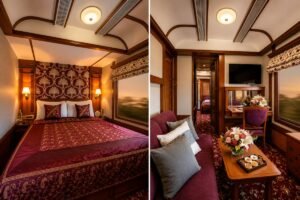
The Deccan Odyssey is designed to make the journeys between destinations part of the holiday rather than simply transportation.
After several hours exploring Ajanta, returning onboard provides a welcome contrast.
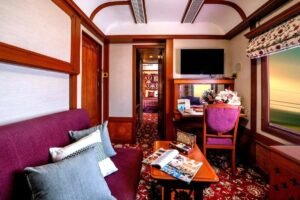
You can enjoy lunch, relax in your cabin, socialise in the public areas or simply watch the Deccan landscape pass beyond the window.
This rhythm—intensive cultural discovery followed by unhurried comfort—is one of the defining pleasures of luxury train travel in India.
Maharashtra Splendour or Maharashtra Wild Trail: Which Should You Choose?
Both journeys visit Ajanta, but they appeal to different travellers.
Choose the Maharashtra Splendour if your interests lean towards heritage, vineyards, architecture, regional culture and the coast. Its combination of Nashik, Ajanta, Ellora, Kolhapur, Goa and Sawantwadi creates a broad portrait of western India.
Choose the Maharashtra Wild Trail if you want to combine UNESCO heritage with wildlife safaris. Pench and Tadoba give the itinerary a much stronger nature and safari dimension.
In both cases, Ajanta remains one of the cultural high points.
Ajanta and Ellora: Two UNESCO Icons on One Journey
One of the strongest reasons to choose either itinerary is the opportunity to experience both Ajanta and Ellora.
The two sites are often mentioned together, but they are remarkably different.
Ajanta draws visitors into a world of Buddhist art, murals and contemplative spaces.
Ellora impresses through the sheer ambition of its architecture and the coexistence of Buddhist, Hindu and Jain monuments.
On the Deccan Odyssey, both are woven naturally into the itinerary, allowing travellers to compare two of India’s greatest rock-cut heritage sites without arranging complicated independent travel.
When Does the Deccan Odyssey Operate?
The Deccan Odyssey generally operates during India’s main luxury rail season, from September to May, according to the train’s current website.
This makes the journeys well suited to travellers planning an autumn, winter or spring holiday in India.
Because the train has limited accommodation and the journeys operate on specific dates, travellers with preferred cabin categories or travel periods should consider booking early.
Who Will Enjoy These Journeys Most?
The Maharashtra Splendour and Maharashtra Wild Trail both suit travellers who want to explore India without sacrificing comfort.
They are particularly appealing for:
- First-time visitors interested in western and central India
- Repeat visitors looking beyond the classic Golden Triangle
- Art and archaeology enthusiasts
- Buddhist heritage travellers
- Wildlife enthusiasts, particularly on the Maharashtra Wild Trail
- Couples seeking an unusual luxury rail holiday
- Travellers who prefer unpacking once rather than changing hotels repeatedly
Ajanta adds intellectual and cultural depth to both itineraries, while the Deccan Odyssey provides the comfort and organisation needed to enjoy the journey at a relaxed pace.
More Than a Visit to the Ajanta Caves
Experiencing Ajanta aboard the Deccan Odyssey is not simply about seeing a UNESCO World Heritage Site.
It is about context.
On the Maharashtra Splendour, Ajanta forms part of a journey through wine country, ancient cave architecture, regional traditions and India’s western coastline.
On the Maharashtra Wild Trail, it follows the thrill of Pench and Tadoba, creating a remarkable transition from India’s wildlife to its Buddhist artistic heritage.
Both journeys demonstrate how varied India can be within a single week.
Experience Ajanta Aboard the Deccan Odyssey
The Ajanta Caves have endured for centuries, preserving stories, artistry and spiritual ideas within the rock of Maharashtra.
To walk through these ancient spaces is to encounter one of India’s great cultural legacies.
To experience them as part of the Deccan Odyssey adds another dimension: the ability to move effortlessly between extraordinary destinations while returning each day to luxury accommodation, fine dining and attentive service.
Whether you choose the Maharashtra Splendour or the Maharashtra Wild Trail, Ajanta is more than another stop on the route.
It is one of those rare places that can become the memory you carry home from the entire journey.
Explore the Maharashtra Splendour, Maharashtra Wild Trail, departure dates and Deccan Odyssey journeys at Deccan Odyssey Luxury Train.